Colonnade
A common zone where identical stone columns stand in rows across the land, holding up nothing.
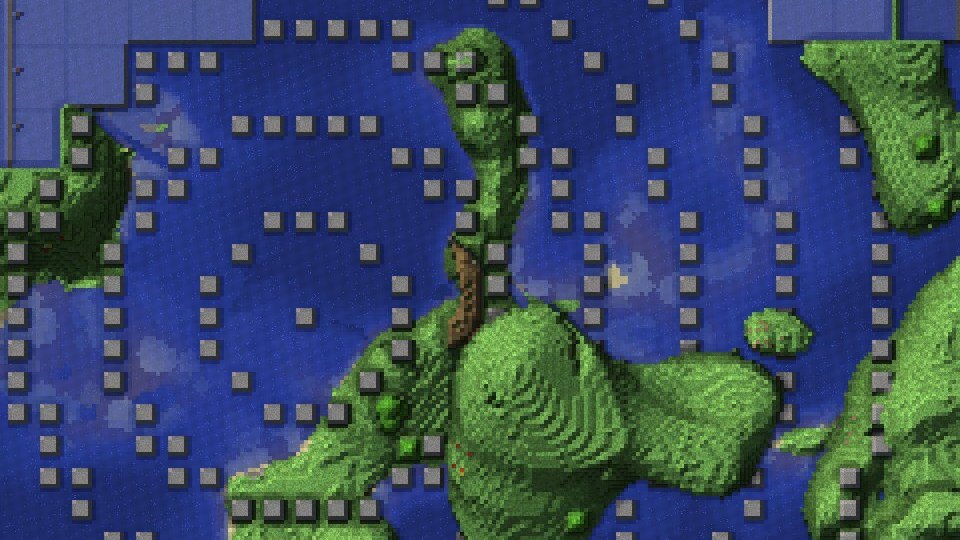
Colonnade is a zone type in the Overworld. Stone columns stand in rows across the zone, all the same and all the same height. There is no roof. It looks as if one was lifted off.
What it looks like
- Each column is three blocks square, with a capital on top that is five blocks square and two blocks thick.
- The columns stand on a grid, 8 or 16 blocks apart. In some zones every point of the grid has a column. In others they stand in a checkerboard, in crossing diagonal rows, in rings around one point, or in square groups with wide aisles between them.
- Every capital in a zone is at the same height, high over the land, so the tops make one level line to the horizon. Columns in valleys are taller than columns on hills.
- In lakes and the sea, the columns stand on the bottom.
- Where a hill reaches the height of the capitals, the column ends in the hillside.
- Nothing in the zone is lit.
The columns are only added on top of the land. No ground is dug out under them.
By biome
Each column is built from blocks that fit the land at its foot.
| Land | Column | Capital |
|---|---|---|
| Most of the world | Polished andesite, or polished deepslate in some zones | Smooth stone |
| Deserts and warm seas | Smooth sandstone | Cut sandstone |
| Badlands | Smooth red sandstone | Terracotta |
| Snowy land and frozen seas | Polished diorite | Stone bricks |
| Swamps and jungles | Mud bricks | Packed mud |
Using them
The columns are ordinary blocks with no protection. There are no ladders or stairs. The tops are dark, so monsters can spawn on them at night.
How rare it is
Colonnade is a common zone. About 3 percent of zones are Colonnade, about one zone in 36. It exists in the Overworld only, and only in land far from anything that existed when it was added. The land around spawn never gets it, so go far.
There are no other chunk errors inside the zone.
See Chunk errors for every zone type, and Exploring for how finds are logged.